<?xml version="1.0" encoding="utf-8"?><feed xmlns="http://www.w3.org/2005/Atom" xml:lang="en"><generator uri="https://jekyllrb.com/" version="3.10.0">Jekyll</generator><link href="https://menna-arafat.github.io/feed.xml" rel="self" type="application/atom+xml" /><link href="https://menna-arafat.github.io/" rel="alternate" type="text/html" hreflang="en" /><updated>2026-09-30T03:55:24+03:00</updated><id>https://menna-arafat.github.io/feed.xml</id><title type="html">Menna Arafat</title><subtitle>Physician and computational biologist building computational frameworks to understand disease biology, model disease trajectories, and enable reprogrammable medicine.
</subtitle><author><name>Menna Arafat</name><email>mennaarafat.md@gmail.com</email></author><entry><title type="html">Disease Trajectories and Reprogrammable Medicine</title><link href="https://menna-arafat.github.io/2025/05/10/disease-trajectories-reprogrammable-medicine.html" rel="alternate" type="text/html" title="Disease Trajectories and Reprogrammable Medicine" /><published>2025-05-10T00:00:00+03:00</published><updated>2025-05-10T00:00:00+03:00</updated><id>https://menna-arafat.github.io/2025/05/10/disease-trajectories-reprogrammable-medicine</id><content type="html" xml:base="https://menna-arafat.github.io/2025/05/10/disease-trajectories-reprogrammable-medicine.html"><![CDATA[<p>Disease is rarely a static state. It emerges through coordinated molecular
changes that unfold across time, tissues, cell types, and regulatory networks.
Understanding those changes requires models that can represent biological
systems as dynamic landscapes rather than isolated lists of altered genes or
metabolites.</p>

<!--more-->

<p>My current research direction focuses on building computational frameworks that
map high-dimensional molecular measurements into interpretable latent spaces.
These spaces can help describe how disease trajectories diverge from normal
physiology, how perturbations propagate through regulatory programs, and where
targeted interventions may shift an unstable biological state toward a more
controlled or healthy configuration.</p>

<p>This is the direction I refer to as reprogrammable medicine: using computational
models to identify actionable molecular states, predict intervention points, and
support therapies that guide biological systems rather than only reacting to
end-stage phenotypes.</p>]]></content><author><name>Menna Arafat</name><email>mennaarafat.md@gmail.com</email></author><category term="systems-biology" /><category term="machine-learning" /><category term="precision-medicine" /><summary type="html"><![CDATA[Disease is rarely a static state. It emerges through coordinated molecular changes that unfold across time, tissues, cell types, and regulatory networks. Understanding those changes requires models that can represent biological systems as dynamic landscapes rather than isolated lists of altered genes or metabolites.]]></summary></entry><entry><title type="html">Multi Omics Integration (MOFA) - Part 1</title><link href="https://menna-arafat.github.io/2025/04/26/multi-omics-integration-mofa.html" rel="alternate" type="text/html" title="Multi Omics Integration (MOFA) - Part 1" /><published>2025-04-26T00:00:00+03:00</published><updated>2025-04-26T00:00:00+03:00</updated><id>https://menna-arafat.github.io/2025/04/26/multi-omics-integration-mofa</id><content type="html" xml:base="https://menna-arafat.github.io/2025/04/26/multi-omics-integration-mofa.html"><![CDATA[<p>Multi-omics integration aims to combine multiple layers of molecular data, such
as transcriptomics, proteomics, epigenomics, and metabolomics, from the same set
of biological samples. One powerful approach for integrating multi-omics data is
matrix factorization, a family of dimensionality reduction techniques designed
to uncover hidden structures or patterns shared across different data types.</p>

<!--more-->

<h3 id="so-what-is-matrix-factorization">So, What Is Matrix Factorization?</h3>

<p>Matrix factorization is a technique used to decompose a large, complex matrix
into simpler, smaller matrices that are easier to analyze and interpret. The
basic idea is to break down the data into underlying factors that explain the
patterns or relationships observed in the original matrix.</p>

<p>Imagine you have a large matrix where columns represent samples, such as tumor
or normal samples, and rows represent gene expression levels across samples. The
matrix is essentially a snapshot of how genes behave across various conditions.
However, this matrix is high-dimensional, making it difficult to directly
interpret how different samples relate to each other based on the raw data.</p>

<p>Matrix factorization aims to reduce this high-dimensional data into a
lower-dimensional space. This lower-dimensional space represents key factors
that capture the major axes of variation in the data. Each latent factor can be
thought of as a vector or axis in this reduced space.</p>

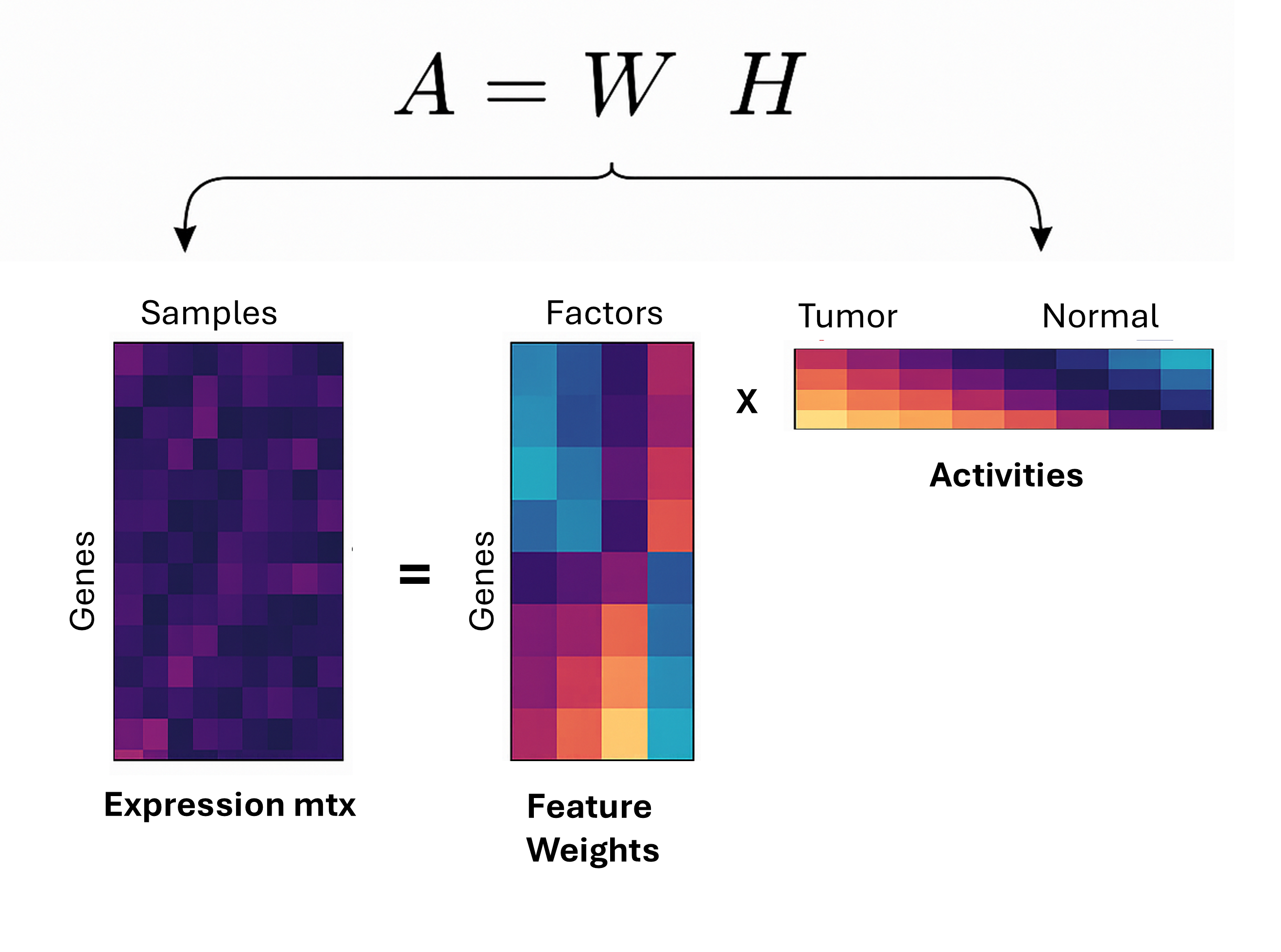
<p>The second matrix produced through matrix factorization is the <strong>activity
matrix</strong>, which represents how much each sample contains of each factor. In
other words, it reflects the activity of the factors.</p>

<p>When you multiply the latent factor matrix by the activity matrix, you get an
approximation of the original matrix but with far fewer parameters. This allows
you to uncover hidden patterns in the data.</p>

<p><img src="/assets/img/MOFA_image.png" alt="Matrix factorization diagram" /></p>

<p>In the previous example, we have an expression matrix (<strong>A</strong>), which is
decomposed into:</p>

<ul>
  <li><strong>Weight matrix (W):</strong> latent factors representing the major axes of variation
in the data.</li>
  <li><strong>Activity matrix (H):</strong> the activity or strength of each factor in each
sample.</li>
</ul>

<p>For instance, tumor samples might have a high activity score for a latent factor
that represents genes involved in cell proliferation or immune evasion,
reflecting the tumor’s biological processes. Normal samples, on the other hand,
might have a low activity score for this same factor, reflecting that these
biological processes are less active in normal tissue.</p>

<p>For the <strong>weight matrix (W)</strong>, the higher the weight, the more important a gene
is in contributing to the factor. In this way, the latent factors discovered
through matrix factorization act like axes or vectors that define the main
directions in the data where tumor and normal tissues vary.</p>

<p>In a more technical sense, these factors are linear combinations of the original
gene expression features, meaning they reflect weighted combinations of genes
that are most strongly associated with the biological differences between tumor
and normal tissues.</p>

<p>By projecting samples onto these latent factors, you can gain a clearer
understanding of how tumor and normal samples differ based on underlying,
biologically meaningful axes. Matrix factorization reveals hidden structure in
the data, allowing you to focus on the key factors driving variation. This can be
used for downstream interpretation, biomarker discovery, or therapeutic target
identification.</p>]]></content><author><name>Menna Arafat</name><email>mennaarafat.md@gmail.com</email></author><category term="multi-omics" /><category term="MOFA" /><category term="bioinformatics" /><summary type="html"><![CDATA[Multi-omics integration aims to combine multiple layers of molecular data, such as transcriptomics, proteomics, epigenomics, and metabolomics, from the same set of biological samples. One powerful approach for integrating multi-omics data is matrix factorization, a family of dimensionality reduction techniques designed to uncover hidden structures or patterns shared across different data types.]]></summary></entry></feed>